German deeptech startup MuRay raises €7.1M to inspect 3D-printed rocket engines with muons

As the commercial space industry races to mass-produce 3D-printed rocket engines, Hamburg-based MuRay has secured €7.1 million to deploy muon imaging—a particle physics technique that can see through thick steel where traditional X-rays fail.
The commercial space sector's reliance on 3D-printed rocket engines has created a critical quality control bottleneck. While additive manufacturing allows for complex internal cooling channels and rapid production, inspecting these dense metal components for microscopic flaws is notoriously difficult. Traditional X-ray imaging can only penetrate a few centimeters of steel, forcing aerospace manufacturers to rely on expensive, destructive testing or risk catastrophic failures on the launchpad.
Hamburg-based deeptech startup MuRay is addressing this blind spot by harnessing muons—subatomic particles that can pass through more than a meter of dense metal. The company announced today it has raised €7.1 million in combined private and public funding to commercialize its Active Muon Imaging technology. The €3.5 million equity portion was led by First Momentum Ventures and Caelora, alongside a €3.6 million grant from the EU's Horizon Europe program.
Unlike passive muon imaging that waits days for cosmic rays, MuRay uses a compact laser-plasma accelerator to generate a controlled muon beam on demand. The startup, led by co-CEOs Andi Hektor and Kristjan Põder, plans to launch its first industrial imaging service in 2027 using the DESY research center's electron beam in Hamburg. By 2029, MuRay aims to deploy a standalone system that allows manufacturers to integrate high-resolution, 3D muon scanning directly into their production lines.
The funding arrives as European launch providers push to establish sovereign, reliable access to space. MuRay is already collaborating with the German Aerospace Center (DLR) to model rocket engine inspections, with physical engine tests slated for 2027. Beyond aerospace, the startup's ability to safely scan dense materials in minutes is drawing interest from international ports seeking to detect shielded nuclear materials in cargo, highlighting the broader security implications of commercialized particle physics.
INTELLIGENCE BRIEF
WHY IT MATTERS
Additive manufacturing has revolutionized rocket engine design, but inspecting dense, complex metal parts remains a major bottleneck. By commercializing active muon imaging, MuRay could eliminate the need for destructive testing and accelerate the deployment of reusable launch vehicles.
WHO IS INVOLVED
MuRay co-founders Andi Hektor and Kristjan Põder; lead investors First Momentum Ventures and Caelora; DESY; German Aerospace Center (DLR).
MARKET IMPACT
The ability to rapidly scan thick metal components on the production line will significantly lower quality assurance costs for aerospace manufacturers. Beyond space tech, the technology opens new avenues for non-destructive testing in energy infrastructure and global supply chain security.
This story was drafted with AI assistance and reviewed by TurkSpark editors before publication. Facts, figures, and names may be inaccurate — verify important details independently.

Rendezvous Robotics Raises $20M to Build Self-Assembling Spacecraft in Orbit
Read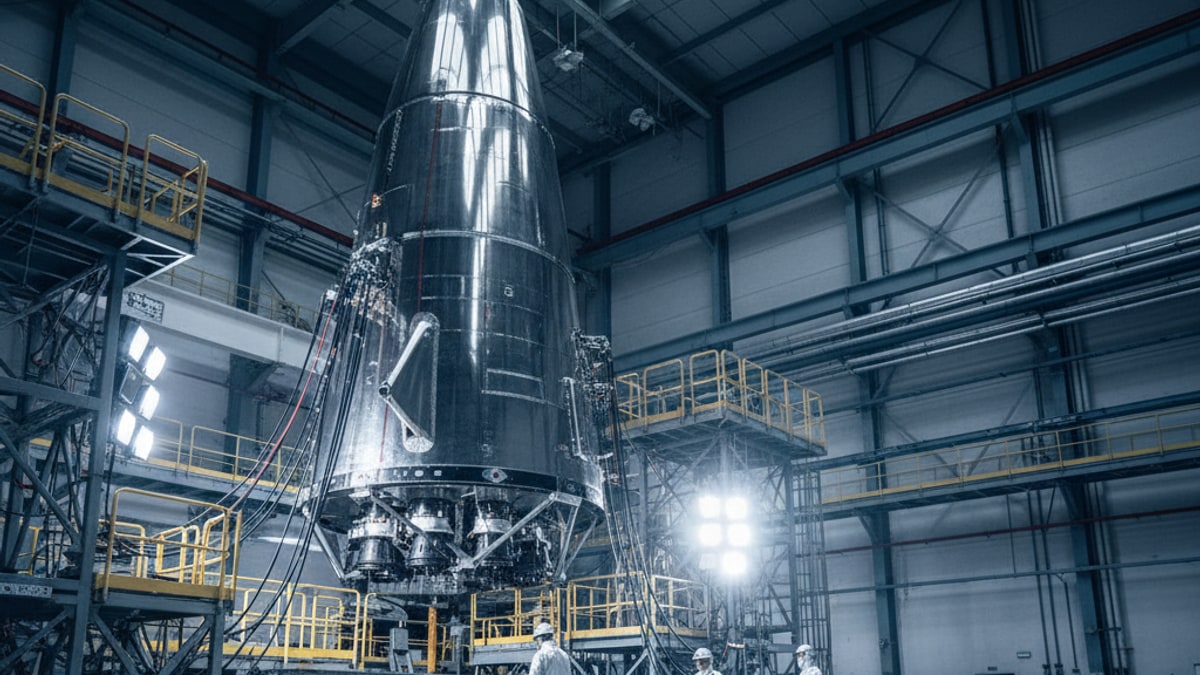
CAS Space Completes Ground Tests for Reusable Lihong 2 Spacecraft Ahead of 2027 Debut
Read