Rendezvous Robotics Raises $20M to Build Self-Assembling Spacecraft in Orbit
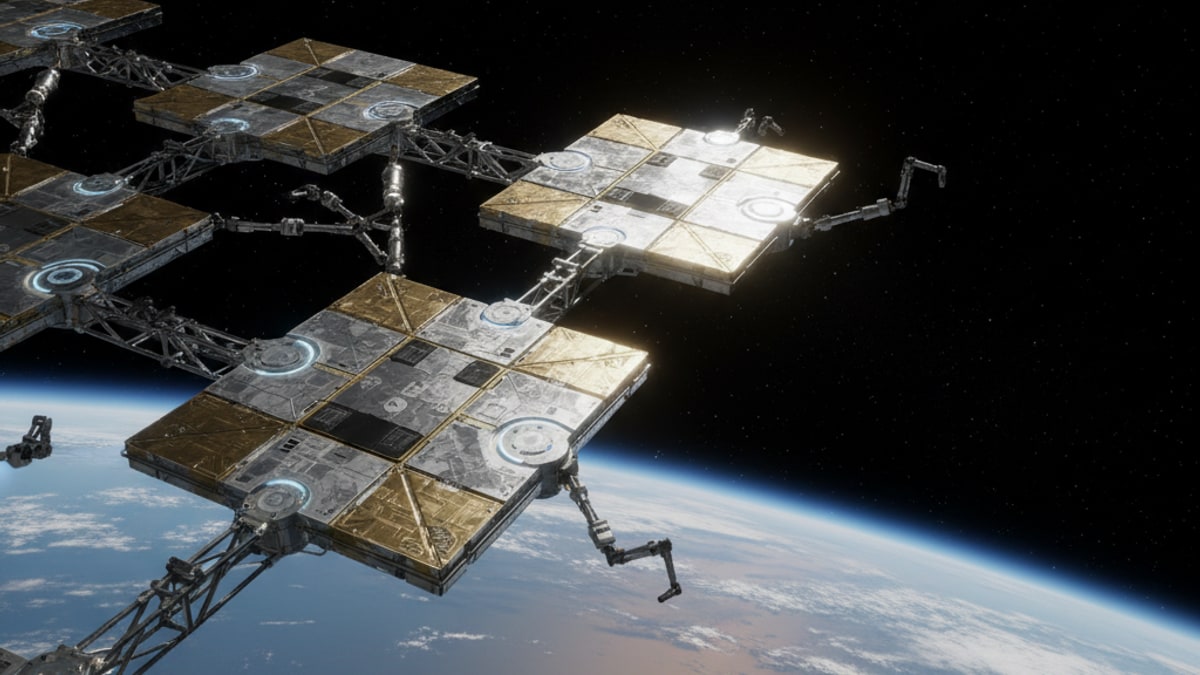
As the commercial space industry races to build orbital infrastructure like data centers and massive solar arrays, the physical size of rocket fairings has become a hard bottleneck. To break this constraint, Colorado-based Rendezvous Robotics has raised $20 million to deploy flat-packed spacecraft tiles that autonomously self-assemble in orbit.
For decades, the size of satellites and space stations has been strictly limited by what can be folded and crammed into the nose cone of a rocket. As companies now look to deploy megawatt-scale power systems and orbital data centers, this volume constraint is stifling the next generation of space infrastructure. To solve this, Golden, Colorado-based Rendezvous Robotics has secured a $20 million Seed round co-led by MaC Venture Capital and Toyota Ventures.
Rather than launching a single massive satellite, Rendezvous builds modular spacecraft that launch as compact, independent tiles. Once in orbit, these flat-packed modules use peer-to-peer swarm robotics and electromagnetic docking to autonomously maneuver, align, and connect into large-scale structures. Based on the TESSERAE technology invented at MIT by co-founder and Board Chair Dr. Ariel Ekblaw, the system removes the need for complex robotic arms or human astronauts to assemble hardware in space.
While competitors focus on in-orbit manufacturing or deploying massive folding mechanisms that introduce single points of failure, Rendezvous treats space infrastructure like dynamic building blocks. If a component fails or a mission changes, the modular tiles can detach, reconfigure, or be replaced. This shift from fixed, fragile satellites to adaptive, self-healing orbital architecture paves the way for infrastructure that is no longer restricted by the diameter of a launch vehicle.
INTELLIGENCE BRIEF
WHY IT MATTERS
The ability to autonomously assemble massive structures in orbit fundamentally changes the economics of space infrastructure. It enables the deployment of space-based data centers and solar arrays that are physically impossible to launch fully assembled inside a rocket.
WHO IS INVOLVED
Joe Landon (Co-Founder & CEO), Dr. Ariel Ekblaw (Co-Founder & Board Chair), MaC Venture Capital, Toyota Ventures
MARKET IMPACT
By decoupling the size of a spacecraft from the size of a rocket fairing, this technology accelerates the transition from basic orbital observation to heavy industrialization in space.
This story was drafted with AI assistance and reviewed by TurkSpark editors before publication. Facts, figures, and names may be inaccurate — verify important details independently.

Opentrons Raises $40M Series E to Standardize Autonomous AI Science
Read
German deeptech startup MuRay raises €7.1M to inspect 3D-printed rocket engines with muons
Read