WIRobotics Unveils ALLEX Humanoid Robot Simulation Model to Accelerate Physical AI Development Ecosystem
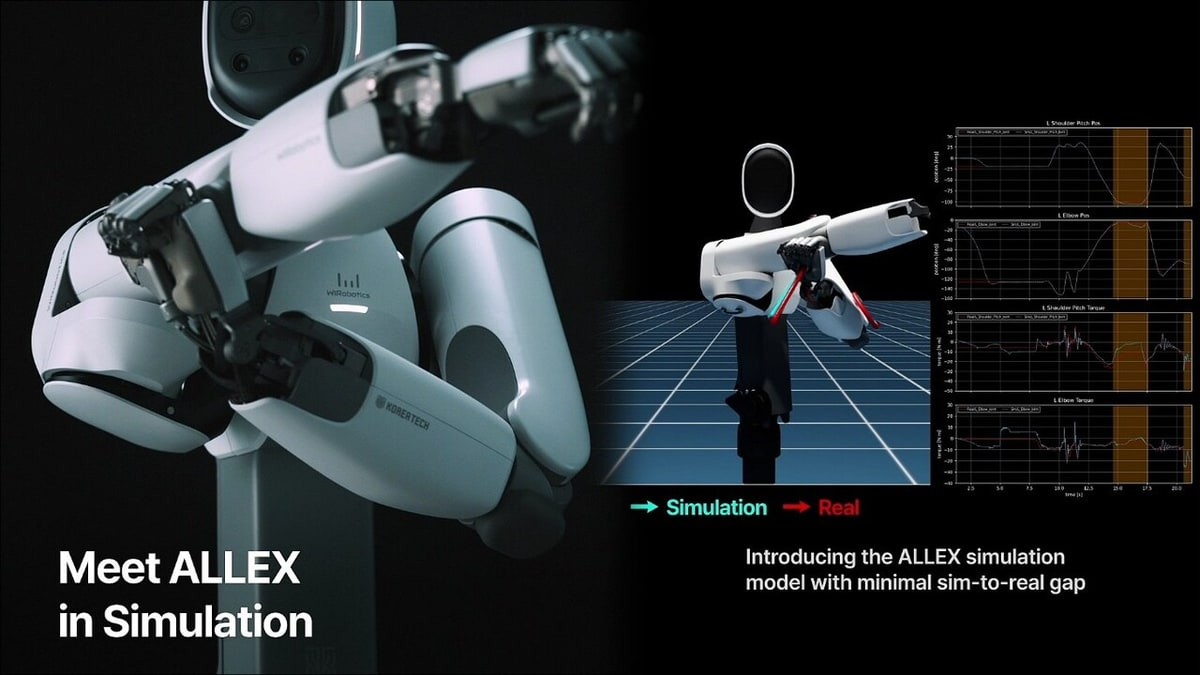
The increasing complexity of robotics demands open development platforms, and WIRobotics is answering this call by releasing its ALLEX humanoid robot simulation model to foster a collaborative Physical AI ecosystem. This move aims to democratize access to advanced robotics development, allowing researchers to innovate without immediate hardware constraints.
The robotics industry is moving towards a more open and collaborative development model, as evidenced by WIRobotics' latest announcement. The South Korean firm, known for its humanoid and wearable robots, has launched a technology disclosure roadmap aimed at fostering a broader Physical AI development ecosystem. This initiative begins with the release of the simulation model for its ALLEX humanoid robot, complete with "Sim-to-Real" validation results.
This move is significant because it allows researchers and developers to experiment with advanced humanoid robotics in a high-fidelity simulation environment, reducing the need for expensive physical hardware. By minimizing the gap between simulation and real-world robot behavior, WIRobotics is addressing a critical challenge in robotics development: ensuring that algorithms and AI models trained in virtual settings perform reliably on actual robots. The ALLEX model, which accurately reproduces the robot's physical characteristics like backdrivability and force transparency, is a key step in this direction.
WIRobotics, founded in 2021 by former Samsung Electronics robotics engineers YounBaek Lee and Yong-Jae Kim, has been a notable player in the field, earning CES Innovation Awards from 2024 to 2026 for its WIM wearable robot series. The company unveiled its ALLEX humanoid robot platform in 2025 and secured a Series B funding round of approximately KRW 95 billion (around $68 million) in 2026, further solidifying its position in the Physical AI landscape. Its selection for the Physical AI Fellowship by NVIDIA and Amazon Web Services in 2026 also underscores its technological competitiveness.
This strategy of opening up core technologies reflects a growing trend in the wider tech industry towards democratizing access to advanced tools, accelerating innovation. For the robotics sector, where hardware development is costly and time-consuming, providing robust simulation models can dramatically lower barriers to entry for AI researchers and developers. This approach could lead to faster advancements in robot control, learning, and synthetic data generation, ultimately bringing more capable and versatile robots into real-world applications.
INTELLIGENCE BRIEF
WHY IT MATTERS
This initiative by WIRobotics is crucial for the advancement of Physical AI, a field where robots interact directly with the physical world. By providing accessible and high-fidelity simulation tools, the company is helping to bridge the gap between theoretical AI models and practical robotic applications, which is essential for the widespread adoption of humanoid robots.
WHO IS INVOLVED
WIRobotics (Co-CEOs YounBaek Lee and Yong-Jae Kim), NVIDIA, Amazon Web Services (AWS).
MARKET IMPACT
The release of open simulation models for humanoid robots could significantly accelerate innovation in the Physical AI market. It enables a broader community of developers to contribute to robotics advancements, potentially leading to more diverse applications and a faster commercialization of intelligent robotic systems across various industries.
This story was drafted with AI assistance and reviewed by TurkSpark editors before publication. Facts, figures, and names may be inaccurate — verify important details independently.
EYOU Robotics Secures Over 200 Million Yuan to Scale Humanoid Robot Joint Production
Read
ModuTech Secures Multi-Million Yuan Pre-A Funding to Advance Tactile AI for Robotics
Read